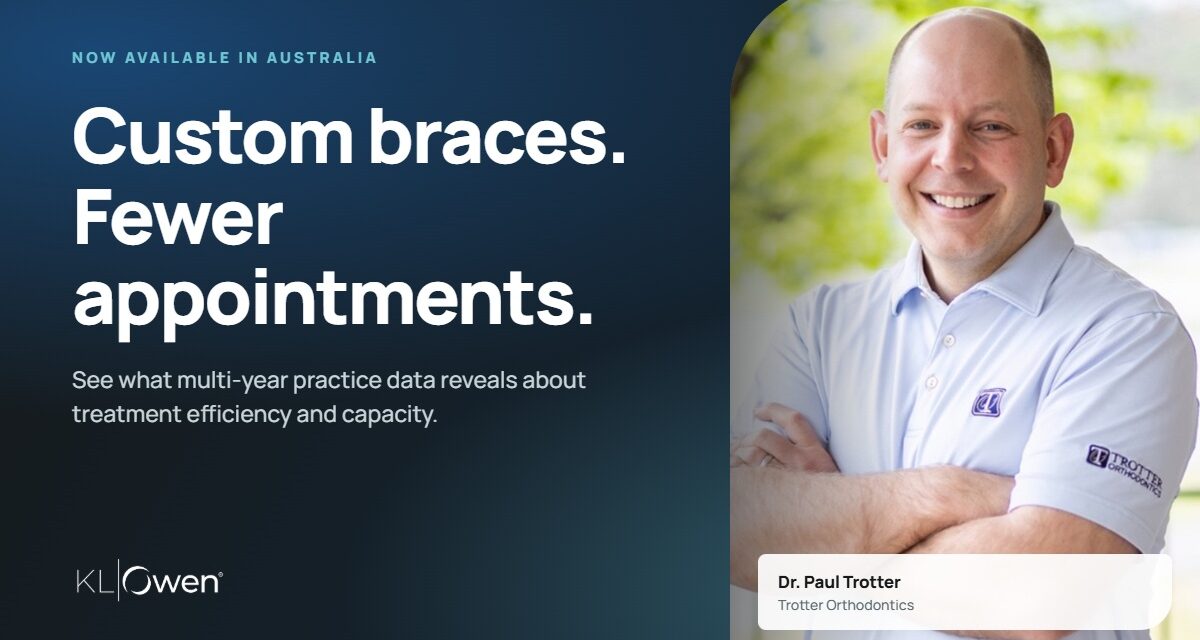
As KLOwen launches in Australia, multi-year practice data offers a closer look at what happens when fixed appliance treatment moves beyond digital workflows to a fully customised prescription.
Orthodontics has become increasingly digital. Scanners have replaced impressions. Treatment planning has moved onto screens. Digital indirect bonding has made bracket placement more precise and repeatable.
But an important question remains: has digitising the workflow fundamentally changed the efficiency of fixed appliance treatment?
Data from KLOwen practices suggests there is an important distinction between making a conventional bracket workflow digital and making the appliance itself custom.
For Australian orthodontists evaluating the next generation of fixed appliance treatment, that distinction matters. The potential impact extends beyond bonding. It can influence the number of appointments required per case, treatment time, repositioning and detailing, doctor chair time, patient convenience and ultimately the capacity of the practice.
One of the clearest examples comes from Dr. Paul Trotter of Trotter Orthodontics, who tracked his practice across four different fixed appliance workflows over multiple years: conventional direct bonding, stock MBT brackets with digital indirect bonding, KLOwen Custom Twin and KLOwen Custom Self-Ligating.
The progression created a useful real-world comparison.
With conventional brackets, his practice averaged 17.4 appointments per case and 22.4 months of treatment. With KLOwen Custom Self-Ligating, those averages fell to 9.7 appointments and 14.6 months. At the same time, revenue per appointment increased from $388 to $732 in his U.S. practice.
The bigger story, however, is not any one number. It is what happened when customisation became part of the entire treatment and practice workflow.
Digital orthodontics and custom orthodontics are not the same thing
Digital indirect bonding offers clear workflow advantages, but the underlying appliance can still be based on a stock prescription.
That distinction is visible in Trotter Orthodontics’ data.
When the practice moved from conventional direct bonding to stock MBT brackets with digital indirect bonding, revenue per appointment increased 22%, while appointments per case decreased approximately 6%.
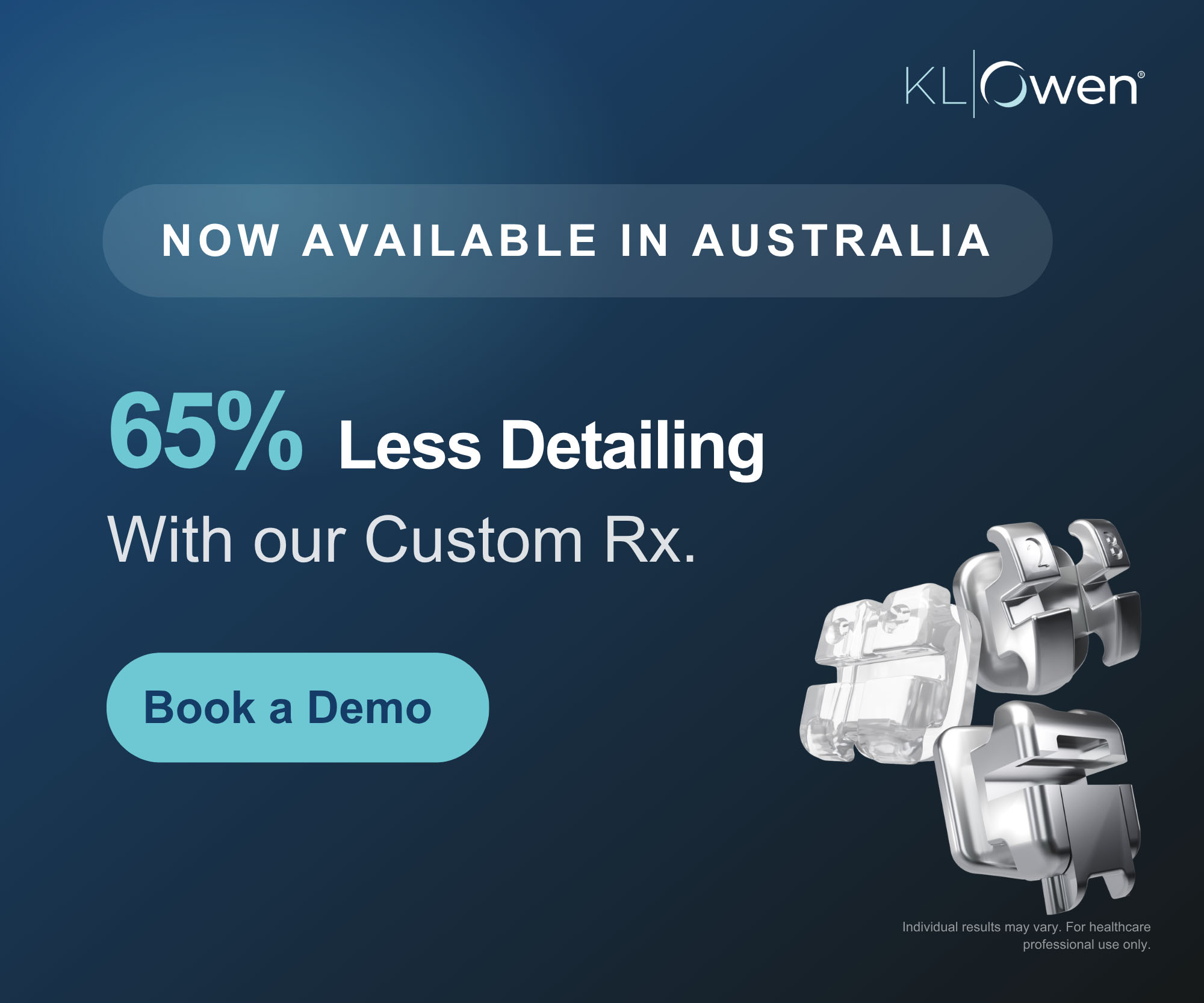
When the practice moved from stock MBT with digital indirect bonding to KLOwen Custom Twin, the change was more significant: revenue per appointment increased another 41%, appointments decreased 14%, and detailing decreased 65%.
The progression continued with KLOwen Custom Self-Ligating, which reduced appointments another 31% compared with Custom Twin.
Why? With KLOwen, custom torque, tip and rotation are designed into the prescription for the individual patient. Rather than starting with a prescription designed for a population and compensating throughout treatment, more of the clinical decision-making happens during digital treatment planning. The goal is earlier expression and a more straightforward path to finishing, with fewer repositioning, wire-change and doctor-intensive detailing appointments.
Digital indirect bonding changes how brackets are placed. Customisation changes the prescription being placed.
Five years of practice data: what changed with custom braces?
Trotter Orthodontics’ multi-year data provides a particularly useful comparison because the practice progressed through each stage rather than comparing unrelated patient populations across different practices.
From the conventional baseline to KLOwen Custom Self-Ligating, average results per case changed as follows:
| Practice metric | Conventional | KLOwen Custom Twin | KLOwen Custom SL | Change |
|---|---|---|---|---|
| Revenue per appointment* | $388 | $670 | $732 | +89% |
| Appointments per case | 17.4 | 14.1 | 9.7 | -44% |
| Treatment time | 22.4 months | 18.3 months | 14.6 months | -35% |
| Detailing | 3.5 | 0.9 | 1.4 | -60% |
| Broken brackets | 4.4 | 1.4 | 1.4 | -68% |
*Trotter Orthodontics U.S. practice data. Financial results are practice-specific and are not Australian benchmarks.
The comparison represents Trotter Orthodontics’ own multi-year Gaidge analytics and should be understood as a single-practice case study rather than an independent or blinded clinical study. Individual results will vary.
Still, the pattern is meaningful: fewer appointments, shorter treatment, less detailing and fewer broken brackets occurred as the practice moved further into a customised fixed appliance model.
And there is broader data pointing in the same direction.
The pattern extends beyond one practice
Data presented across four additional KLOwen practices, each with more than 100 KLOwen cases, compared results with a conventional baseline of more than 300 finished cases across multiple practices.
Across those KLOwen practices, the reported averages included:
- 7.1 fewer appointments per patient
- 31% reduction in active treatment time
- 81% fewer repositioning appointments
- 45% fewer detailing appointments
- 49% fewer broken brackets
The conventional comparison group averaged 24.8 months of treatment, 18.3 appointments and 4.6 detailing or repair appointments per case.
For an orthodontist, those are not simply clinical workflow metrics. Each avoided appointment has implications for the patient, the doctor, the team and the practice schedule.
Fewer appointments can change the patient experience
The efficiency conversation is often framed around practice economics, but there is an equally important patient consideration.
Every orthodontic appointment requires time. For an adult patient, that may mean leaving work. For a parent, it can mean rearranging their schedule and collecting a child from school. For families who live farther from the practice, each appointment adds travel as well.
Trotter Orthodontics found that fewer scheduled appointments allowed the practice to create longer treatment intervals, paired with remote monitoring when appropriate, while targeting fewer than 10 appointments for certain treatment workflows.
That creates an experience more closely aligned with one of the things patients have come to appreciate about clear aligner treatment: fewer disruptions to everyday life.
Custom fixed appliances therefore offer an interesting proposition. They preserve the clinical control of braces while applying digital treatment planning and patient-specific customisation to create a potentially lower-intervention workflow.
The hidden constraint may be doctor-dependent appointments
When orthodontic practices reach capacity, the conventional response is often to add resources. Add another clinical day. Add chairs. Hire more assistants. Recruit an associate.
But before adding capacity, there is another question worth asking: How much of the existing appointment load actually needs to exist?
A conventional prescription can create additional interventions as treatment progresses. Repositioning a bracket, placing a detailing bend or making another finishing adjustment does more than consume a chair. It often requires the orthodontist.
The supporting KLOwen materials describe this as a series of compounding costs: a time tax, because reactive adjustments consume high-value chairside hours; a capacity tax, because additional appointments occupy capacity that could otherwise support new patients; and a decision burden, because each repositioning or detailing decision requires fresh clinical judgement.
That reframes practice efficiency. The question is not simply, “How quickly can we get through today’s schedule?” It becomes, “How many of today’s appointments could have been designed out of treatment in the first place?”
What happened when one practice stopped adding doctor capacity
For Dr. Trotter, this question became very real when his father retired.
The practice went from 1.5 doctors to one while continuing to operate two full-scale locations. Demand was not the problem. The challenge was determining whether one orthodontist could support continued growth without immediately hiring another doctor.
Rather than looking at KLOwen as an isolated technology purchase, Trotter redesigned the operating model around it. The practice combined customised braces with digital scanning, structured lab workflows, schedule redesign, remote monitoring and KPI management.
The resulting practice-wide numbers are notable.
From 2022 through 2025, net production increased 27%, while total appointments increased only 11%. In 2025, the first full year using KLOwen Custom SL, production increased 16.1% while total appointments increased just 1.2%.
That gap is important. Growth did not require appointment volume to increase at the same rate as production.
New case starts also increased from 476 in 2021 to 635 in 2025, a 33% increase, with the same one-doctor model.
This does not mean every practice can or should avoid adding an associate. It means there may be value in removing preventable appointment load before hiring into an inefficient system.
Efficiency also has to be trainable
A sophisticated clinical system is not efficient if only the orthodontist can operate it.
For customisation to translate into capacity, the workflow has to become repeatable for the team.
Trotter Orthodontics reported that a new assistant progressed to performing full KLOwen bondings within three months, supported by a KLOwen Practice Development Specialist and quarterly recalibration.
That highlights another important component of custom orthodontics: the appliance itself is only part of the system.
The practice needs consistent digital intake, treatment planning, bonding, scheduling and team protocols so that the efficiencies created clinically are captured operationally.
Trotter’s experience also showed that implementation has a learning curve. His early Custom SL cases produced more ER/comfort appointments than his conventional baseline, attributed in the source data to issues such as open doors and pigtail wires. That metric is important to disclose because successful implementation is not instantaneous.
The lesson from his experience was not that customisation eliminates every challenge. It was that training, consistency and full implementation mattered to achieving the efficiencies he ultimately measured.
Practice efficiency is more than appointments per case
Trotter Orthodontics’ broader operating metrics also offer a view into what an efficient fixed-appliance practice can look like.
An independent practice evaluator reported $240,000 revenue per full-time equivalent employee, compared with a cited bracket-centric benchmark of $180,000 to $220,000; 20–21% staff cost as a percentage of revenue; 53–57% practice overhead, compared with a cited U.S. industry average above 60%; and recent annual growth rates of 12%, 6% and 10%, compared with an approximately 3% long-term U.S. industry average cited in the evaluator’s report.
These figures are U.S.-based and should not be interpreted as Australian orthodontic benchmarks. Their value is in illustrating how Trotter’s clinical workflow connected to the economics of his individual practice.
In other words, clinical efficiency only becomes business efficiency when the capacity it creates can actually be used.
What this means for Australian orthodontists
KLOwen’s launch in Australia brings another option to practices that have embraced digital orthodontics but still rely largely on conventional fixed appliances.
The opportunity is not simply to digitise another part of the workflow. It is to ask whether fixed appliance treatment itself can be designed differently.
For practices evaluating custom braces, there are several useful questions to consider:
- How many appointments does your average braces case require today?
- How much of your finishing is doctor-dependent?
- How frequently are you repositioning brackets or adding detailing appointments?
- How much chair capacity could be created if each braces case required even two or three fewer appointments?
- Could those efficiencies improve patient convenience without sacrificing the control you want from fixed appliances?
- If your practice is growing, are you truly out of capacity, or are preventable appointments consuming the capacity you already have?
Those questions are more useful than simply asking whether custom brackets cost more than stock brackets.
The relevant calculation is the total cost to deliver treatment, including the number and type of appointments required to finish the case.
The next evolution of fixed appliances may be custom
Clear aligners changed expectations around digital treatment planning and patient-specific treatment.
Custom braces apply a similar principle to fixed appliances: plan digitally, customise the prescription to the patient and use that planning to reduce the reactive work required later.
The data from Trotter Orthodontics is compelling precisely because the practice experienced the progression itself. Digital indirect bonding improved efficiency. Custom Twin improved it further. Custom Self-Ligating moved the numbers again.
Across the full journey from conventional brackets to KLOwen Custom SL, Trotter Orthodontics reported 44% fewer appointments, 35% shorter treatment time, 60% less detailing and 68% fewer broken brackets per case, alongside an 89% increase in revenue per appointment in its U.S. practice.
For Australian orthodontists, the takeaway is not that every practice will reproduce those numbers. It is that customisation creates a different question about what fixed appliance treatment can look like.
Instead of accepting repeated adjustments, repositioning and doctor-intensive finishing as an unavoidable part of braces treatment, it becomes possible to design more of the treatment upfront.
Fewer appointments for patients. Less doctor-intensive finishing. More predictable scheduling for the team. More capacity within the practice.
That is where customisation moves beyond the bracket itself and becomes a practice strategy.
See KLOwen in Australia
KLOwen custom digital braces are now available in Australia.
Book a demo to see how KLOwen’s customised fixed appliance workflow works and explore what fewer appointments could mean for your practice.
Important disclosure: Results cited from Trotter Orthodontics reflect a single-practice, multi-year case study and are not an independent or blinded clinical study. Broader multi-practice results are identified separately. Individual treatment outcomes, treatment times and practice results may vary. U.S. financial and practice benchmarks are provided for context only and should not be interpreted as Australian benchmarks. Product availability varies by country.